Known vulnerabilities
Severity, CVSS, and likelihood of exploit across the direct and transitive dependencies in the graph.
Reviews the code and dependencies in each pull request, several layers deep, and returns a merge decision and a fix across the repositories you own.
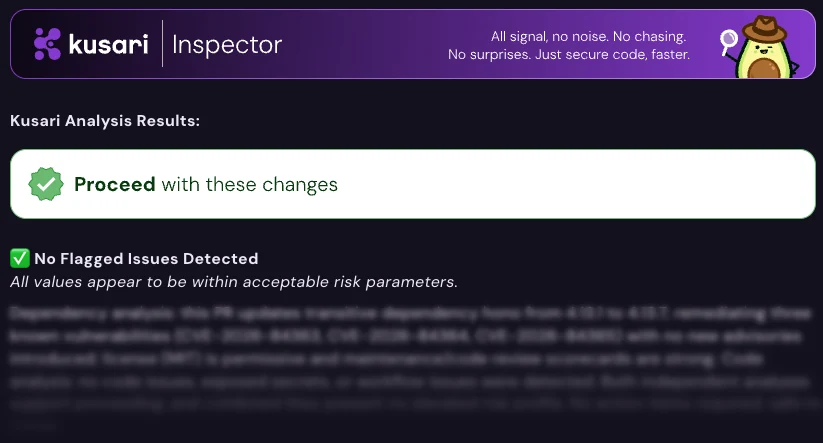
Inspector reviews each pull request inside GitHub, GitLab, and the CLI. 96% of software vulnerabilities sit at least two layers below the dependency a developer changed.
Inspector runs a suite of established open source analyzers over the changed files, then reads the surrounding code before a finding posts.
Inspector reads its configuration from your workspace, your GitHub organization, and each repository, with a kusari.yaml file at the repository root taking precedence over all of them. When an auditor asks why a finding was accepted, the answer is an exception an admin approved.
A self-guided tour of transitive dependency findings, the fix in context, and the merge decision, shown the way your developers see it.
Inspector runs across the changed files and the full dependency graph on each pull request, and enforces your security policy the same way whether a person or a coding agent wrote it.
Severity, CVSS, and likelihood of exploit across the direct and transitive dependencies in the graph.
The layers below the package a developer changed, several levels deep, with the path that pulled each one in.
API keys, tokens, and credentials caught before they land in your git history.
Dependency names that shadow a real package, including ones a coding agent suggested.
Copyleft and permissiveness categorized per dependency, so license review happens at review time.
The security posture of each dependency's own repository, including projects that have gone quiet.
Static analysis over the changed files, read against the surrounding code for context.
GitHub workflow, Dockerfile, Terraform, and Helm chart issues, plus unpinned action and container versions.
Four stages run on every pull request, in order. Connect once, and the remaining three happen on each change without anyone asking for them.
Inspector covers the languages and infrastructure config below and installs onto the review your team already runs, so one security standard reaches a polyglot org through the tools each group has chosen.
Reviews pull requests natively and posts the merge decision as a comment.
Setup guideDrops into an existing workflow and fails the check on findings when you ask it to.
Setup guideReviews merge requests inside the code review your team already runs.
Setup guideReady-made templates to add Inspector to a build on the provider you already use.
CI templatesRuns the same analysis locally, before a pull request is opened.
Setup guideReturns findings in the editor and to the agents writing alongside you.
View integrationsGives a coding agent a security check it can call while it works.
View integrationsTo add Inspector Pro to your Kusari Platform subscription, contact your sales representative.
Inspector analyzes the changed files and the dependency graph, and does not store your code in any form. Once the analysis finishes, the input is deleted. Data is encrypted in transit and at rest, and Kusari is SOC 2 Type II compliant.
Yes. A Dependabot pull request gets the same review as any other change. These are the pull requests where a single version bump moves transitive dependencies several layers down, and the diff a reviewer sees is a version number. Inspector reports what changed underneath it.
Inspector sits alongside them. Dependabot opens a pull request when a newer version is published, and CodeQL analyzes the code your own team wrote. Inspector reviews the pull request itself: the dependency graph several layers past the manifest, how the flagged component is called in your code, and the version change that resolves the finding at its root. Output from the scanners you already run feeds the Kusari Platform, which is the estate-wide view above all of them.
Yes. You can create an exception that suppresses a specific finding while the rest of the analysis stays active, so an accepted risk stops reappearing on every pull request. Exceptions require admin approval before they take effect.
Inspector analyzes pull requests with up to 2,000 total dependency changes, and examines up to 1,000 high-priority dependency changes in depth.
Go (go.mod, go.sum), Node.js (package-lock.json, yarn.lock), Python (requirements.txt, poetry.lock, Pipfile.lock, uv.lock), Java (pom.xml, gradle.lockfile), .NET (.csproj, .vbproj, .fsproj), Ruby (Gemfile.lock), and Rust (Cargo.lock).
Inspector also reads HashiCorp Configuration Language, which covers Terraform and OpenTofu, along with Dockerfiles, GitHub workflow files, and Helm charts.
The GitHub App is free to install and review your pull requests. Agentic Analysis, SBOM generation, and the estate-wide capabilities of the Kusari Platform are part of a paid plan.
Install the GitHub App, pick your repositories, and the next pull request gets reviewed.